
Healing Resources
Support for your journey—whether you’re struggling, standing beside someone who is, or simply learning.
Emotional & Mental Health
You are not alone. These resources are here to help support your emotional and mental well-being.
Crisis Support
You are not alone. If you’re in crisis or supporting someone who is, please reach out to one of these trusted resources:
- National Suicide & Crisis Lifeline: Call or text 988 (24/7 support in the U.S.)
- Crisis Text Line: Text HOME to 741741 to connect with a trained counselor
- Domestic Violence Hotline: Call 800-799-SAFE (7233) or visit thehotline.org
Therapy Types Glossary
Explore a few common types of therapy that support healing and emotional well-being:
- EMDR: Trauma therapy using eye movements or bilateral sound/touch to reprocess painful memories
- CBT: Helps shift negative thinking patterns and behaviors into healthier ones
- Brainspotting: Accesses trauma through fixed eye position and body sensations
- Somatic Therapy: Focuses on how trauma lives in the body and helps release it physically
- Talk Therapy: Traditional one-on-one therapy with a counselor or psychologist
Find a Therapist Tools
These online directories can help you find a therapist who fits your needs and values:
- Psychology Today – Filter by location, insurance, and specialty
- Open Path Collective – Affordable therapy for uninsured individuals
- Inclusive Therapists – Focused on cultural sensitivity and trauma-informed care
Addiction Recovery
Whether you’re walking through addiction or walking beside someone who is, healing is possible.
Grace for the Journey
Addiction is not a moral failure. It’s a wound that seeks relief. Recovery begins with compassion—for yourself and for your healing path.
You don’t have to be “perfect” to begin. You just have to be willing. Whether you are in the middle of the struggle, newly sober, or years into recovery, this space is a reminder: You are not alone, and you are worthy of healing.
Start where you are. Come as you are. And know that grace is big enough to carry you.
Resources for Recovery
- SMART Recovery – A science-based program using cognitive therapy tools and mutual support
- Alcoholics Anonymous – Peer-led 12-step program with in-person and online meetings
- Narcotics Anonymous – Support for people recovering from drug addiction
- SAMHSA National Helpline – Free, confidential help available 24/7: 1-800-662-HELP (4357)
Supporting a Loved One
Watching someone you love struggle with addiction is heartbreaking—and it’s also exhausting.
You may feel powerless, confused, frustrated, or even guilty. But your role is not to fix them. Your role is to love them while staying grounded in your own truth and boundaries.
Here are some gentle reminders:
- Listen without judgment. Compassionate presence often does more than advice.
- Don’t enable. Loving someone doesn’t mean protecting them from consequences. It means being honest while keeping your heart open.
- Take care of yourself. Set boundaries. Breathe. Talk to someone. You need support too.
- Offer resources, not pressure. Gently point them toward help—when they are ready.
You can love deeply and still honor your peace. You can hope for them and still let go of trying to control the outcome.
You are doing enough. You are enough.
A Prayer for the Journey (Serenity Prayer)
“God, grant me the serenity
to accept the things I cannot change,
courage to change the things I can,
and wisdom to know the difference.”
Whether you are on your own recovery path or walking beside someone who is, this prayer is a quiet anchor—a reminder that even in chaos, there is clarity. Even in struggle, there is grace.
Take a breath. Speak the words. Let them settle in your spirit. One moment, one step, one day at a time.
Grief and Loss
Grief is not a problem to be solved—it’s a process to be honored.
Grief & Loss – Understanding & Honoring Your Journey
Grief is a sacred expression of love and loss. Whether you are grieving a person, a relationship, or a season of your life, know that your emotions are valid, and healing takes time. This section offers understanding, comfort, and resources for your journey.
🌊 The Five Stages of Grief
Grief doesn’t follow a straight line. These stages may not happen in order, and you may revisit them multiple times. This is normal.
- Denial: “This can’t be happening.” A natural first response that helps us survive the initial shock.
- Anger: “Why did this happen?” Anger can feel overwhelming, but it’s often a sign of deep love or pain.
- Bargaining: “If only I had…” A way our minds try to regain control during chaos.
- Depression: “This hurts too much.” A deep acknowledgment of the reality and depth of the loss.
- Acceptance: “This is my reality now.” It doesn’t mean you’re ‘over it’—just that you’re beginning to integrate your loss into life moving forward.
📞 Resources & Support
If you are feeling overwhelmed or need someone to talk to, these resources are here for you:
- GriefShare Support Groups – Find local and online support groups.
- Crisis Text Line – Text HOME to 741741 to connect with a trained crisis counselor (24/7).
- 988 Lifeline – Call or text 988 for emotional support in times of distress.
- The Dougy Center – Grief resources for children, teens, and families.
🤍 Remember: You Have a Private Space
When grief becomes too heavy to carry alone, return to your Grace to Grieve room in your Becoming Space. There, you’ll find gentle prompts, sacred tools, and a soft place to land in your most tender moments.
You don’t have to hold it all at once. Healing comes in layers. And grace will meet you in every one.
Self-Help & Spiritual Growth
A sacred space to nurture your inner journey—with tools, teachings, and truths that support your healing, growth, and transformation from the inside out.
Books That Heal & Empower
Words can be medicine. Here are a few powerful books that have brought healing, clarity, and strength to many on their journey:
- “The Body Keeps the Score” by Bessel van der Kolk – A deep dive into how trauma shapes the body and mind—and how to begin healing.
- “Untamed” by Glennon Doyle – A fierce call to reclaim your voice, worth, and wild truth.
- “Try Softer” by Aundi Kolber – A gentle approach to trauma recovery, teaching us to move forward with compassion instead of force.
- “Boundaries” by Dr. Henry Cloud & Dr. John Townsend – Learn the power of saying “yes” and “no” in a way that protects your peace.
- “Healing the Shame that Binds You” by John Bradshaw – A foundational book on releasing shame and rebuilding self-worth.
Consider choosing one book to read this season. Let the words meet you where you are and guide you to where you’re becoming.
Faith & Spiritual Encouragement
In seasons of pain or uncertainty, faith can become your anchor. Here are a few tools to nourish your spirit and remind you of who—and Whose—you are:
- Daily Scripture: Pick one verse and meditate on it throughout the day. Example: “The Lord is close to the brokenhearted and saves those who are crushed in spirit.” – Psalm 34:18
- Devotional Readings: Use platforms like YouVersion or She Reads Truth for guided devotions centered around healing and purpose.
- Spoken Prayers: Don’t worry about having the right words. Speak to God honestly and openly—He hears the unspoken too.
- Worship & Music: Let worship music wash over you. Try playlists like “Peaceful Worship” or “Healing Worship” on Spotify or YouTube.
Remember: Faith doesn’t remove the pain, but it helps carry you through it—with grace.
Boundaries & Becoming
- Start small: Set one emotional, relational, or physical boundary this week that protects your peace.
- Use language that honors you: “I’m not available for that right now.” “That doesn’t feel safe for me.” “I need some space to process.”
- Check in with yourself: If something drains you or causes anxiety, it may be a sign that a boundary is needed.
- Affirmation: “I am allowed to protect my peace. I am allowed to grow beyond the expectations of others.”
Boundaries aren’t walls. They’re bridges to the healed, empowered version of you—your becoming.
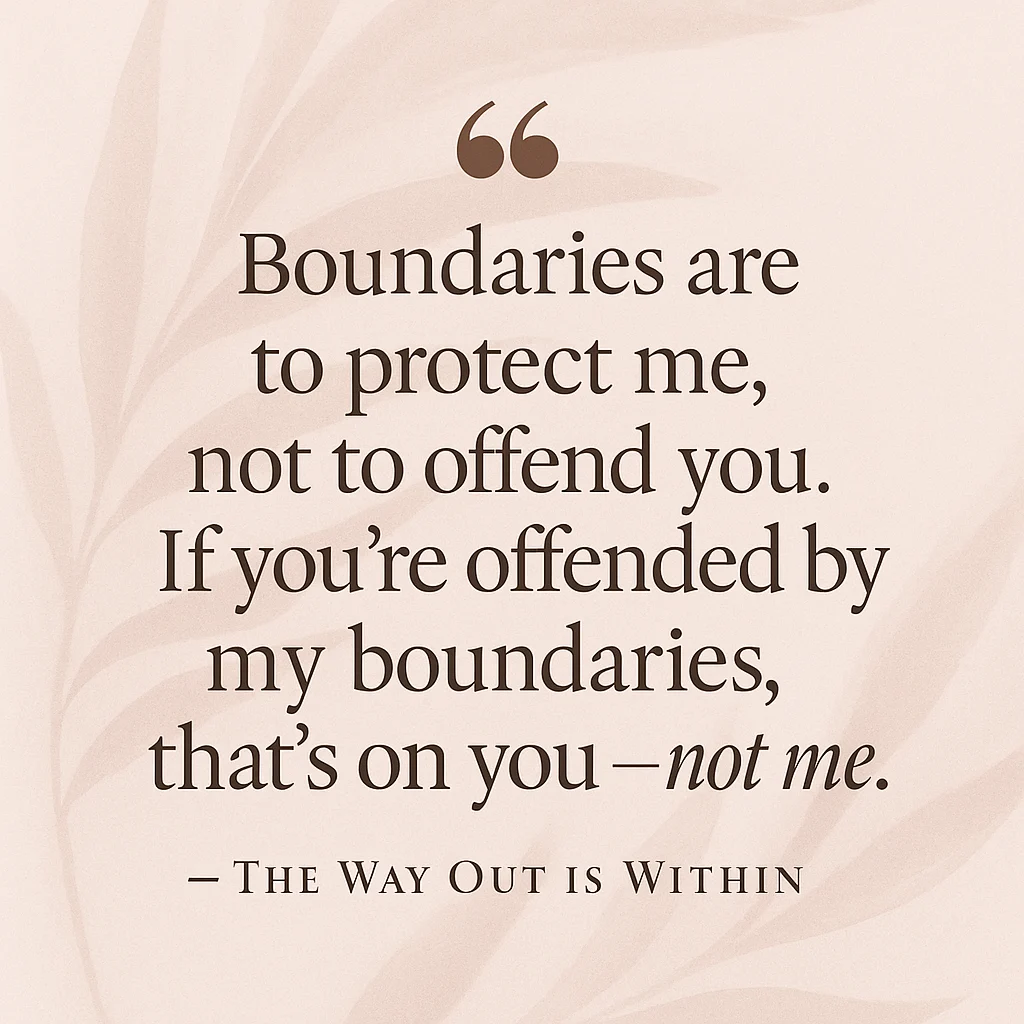
Reminder: Boundaries are to protect you, not to offend anyone. If someone is offended by your boundaries, that’s on them—not you.

Boundaries are love in action.
Click below to save this reminder to your device: